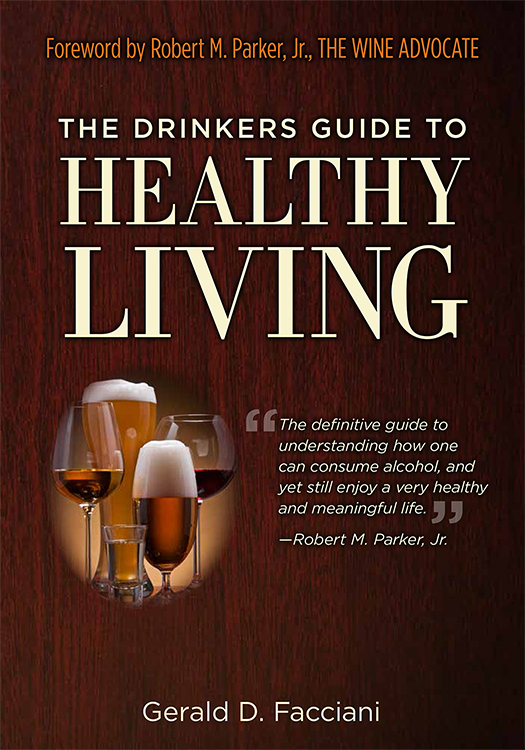
The Drinker’s Guide To Healthy Living

20 10 2014

GetInline

Now available at:
www.drinkersguidetohealthyliving.com or on Amazon in print & eBook
The Drinkers Guide To Healthy Living represents the culmination of 15 years of observation, analysis, study and experimentation dealing with the following question: Is it possible for individuals to be supremely healthy even though they consume significant amounts of alcohol on a daily basis? This is not a simple question, given the multiplicity of issues to be considered. For example, is any amount of alcohol consumed on a daily basis “too much?” Is there such a thing as healthy “moderate” drinking and, if so, what are the definitional parameters? What about differences in gender? For example, are women more susceptible than men to the detriments of alcohol at any level of consumption? What about differences in race and ethnicity? For example, are Asians more prone to negative health ramifications as a result of imbibing any type of alcohol? Does genetics play a role, that is, are certain otherwise healthy people at greater risk for alcohol-related health problems due to their genetic codes?

In considering these fundamental questions, myriad other issues come into play, such as whether or not physical exercise routines play a significant role in healthy living for drinkers. Also, to what extent does stress impact drinkers? Many people get by on less sleep than they should, but does this really result in additional negative consequences for drinkers? Does consuming any level of alcohol add to the load of environmental toxins by which all of us is impacted every day? Is the combined impact of all these factors further impacted by age?

The Drinkers Guide To Healthy Living addresses all these subject areas and provides access to substantial additional information for any reader interested in a particular subject area. The book also focuses on the critically important role of diet and nutrition, and it spends significant time analyzing the degree to which daily supplementation of various vitamins, minerals, trace elements, amino acids and fatty acids aids a person in being as healthy as possible, consistent with drinking alcoholic beverages.

The author is a firm believer in the principle that each individual must take control of her or his life. As a drinker of alcoholic beverages for many years, the author has personally tested his theory that lifestyle modifications can influence one’s health, no matter whether a person is a moderate or immoderate drinker. The final chapter of the book lays out the author’s personal health regimen, as well as his most recent medical results.

This book is a must read for anyone interested in achieving optimal health benefits while continuing to drink alcoholic beverages.


Indie Bookstores Aren’t Dead — They’re Making A Comeback

6 10 2014

Hooray!!!

http://www.huffingtonpost.com/kevin-okelly/indie-bookstores-arent-de_b_5884584.html


SCIENCE HAS GREAT NEWS FOR PEOPLE THAT READ ACTUAL BOOKS

2 10 2014

Being a diehard ink on paper kinda gal, this is one of my all time favorite articles!

http://mic.com/articles/99408/science-has-great-news-for-people-who-read-actual-books?utm_source=October+2%2C+2015&utm_campaign=August+7th+newsletter&utm_medium=email


Technology Literary Lions Unite in Protest Over Amazon’s E-Book Tactics – request Justice Dept. to investigate!

29 09 2014

Yikes!  Oh boy, here we go….


50 BOOK AWARDS OPEN TO SELF-PUBLISHERS

22 09 2014

Re-post from Dan Poynter’s eNewsletter 9/22/2014

These fifty awards represent a range of competitions from ones
that are ongoing to monthly, annual or bi-annual for a variety
of genres and book types.
They all have one thing in common: they are open to
self-publishers!
See http://www.selfpublishingadvice.org/50-book-awards/
And http://blog.bibliocrunch.com/indie-author-awards-
2013/?goback=%2Egde_61034_member_5814022188595965956#%21


Kindle Voyage leaks on Amazon with a new way to turn pages

17 09 2014

http://www.theverge.com/2014/9/17/6323519/kindle-voyage-amazon-specifications-rumor


Seeking Under-40 Printing Industry Rising Stars

12 09 2014

PHILADELPHIA—Is there an executive shooting star in your organization who has yet to reach the tender age of 40? If so, Printing Impressions wants to find out more.

We will be featuring a profile on the industry’s under-40 movers and shakers in the November issue of PI. If you have someone within your organization (printers only) who you think fits the description, please send us a quick e-mail with the candidate’s biographical particulars (name, age, company, contact information).

Candidates are not required to be presidents or CEOs, but they should have reached some level on the company’s executive hierarchy.

To submit your nomination, e-mail Erik Cagle at ecagle@napco.com. The final list will be selected by the magazine’s editorial staff. Deadline for submission is Oct. 3.


Shares of Barnes & Noble rose to a two-year high

9 09 2014

Yippee for the brick and mortar store!

http://www.reuters.com/article/2014/09/09/us-barnes-noble-results-idUSKBN0H41B720140909


1ST CALL: 2015 ERIC HOFFER AWARDS

3 09 2014
FIRST CALL:  THE 2015 ERIC HOFFER BOOK AWARD
 
SMALL PRESSES  * ACADEMIC PRESSES  * MICRO PRESSES  *  SELF-PUBLISHERS -- $2,000 GRAND PRIZE -- LOW ENTRANCE FEE
 
New or old, we want to read your book. … Each year, independent publishers release extraordinary books to little or no recognition. The Eric Hoffer Book Award recognizes excellence in publishing. A SINGLE REGISTRATION gives you SIX WAYS TO WIN by genre, press, the Montaigne Medal, the da Vince Eye, the First Horizon Award, and the Hoffer grand prize. There is a category for every book. (See submission guidelines below or check our listing in Writer’s Market or visit www.HofferAward.com.) E-books also accepted.
 
          * $2,000 GRAND PRIZE * Low Entrance Fee of $55 * Many Categories *
 
AWARDS/BENEFITS:
* $2,000 GRAND PRIZE (the Eric Hoffer Award for Books)
* Winner of the Montaigne Medal for most thought-provoking books
* Winner of the da Vinci Eye for best covers
* Winner of the First Horizon Award for debut authors
* Winner and First Runner-Up awarded for every category 
* Honorable Mentions for every category
* Individual Awards for Micro, Small, and Academic Presses, as well as Self-Published Books
* Coverage in The US Review of Books (www.theUSreview.com) and on www.HofferAward.com
* Gold Seal Certificates
* Worldwide Exposure
 
CATEGORIES: Art, Poetry, General Fiction, Commercial Fiction, Children, Young Adult, Culture, Memoir, Business, Reference, Home, Health, Self-Help/Spiritual, Legacy Fiction, Legacy Nonfiction, E-book Fiction, and E-book Nonfiction.
 
In this tough economic time, your book is always a great value, and the Eric Hoffer Book Award is the most economical way to achieve publicity and recognition. Read previous contest coverage in the US Review of Books (www.theUSReview.com) and view past winners and press releases at www.HofferAward.com.


“Self-Publishing” vs. “Printing” a Book

13 08 2014

Re-post from:  The Cadence Group

A couple of weeks ago we wrote a blog titled “The true costs of self-publishing.” It got a lot of comments and activity – in particular in several LinkedIn Groups. Some people agreed with our assessment, some didn’t. We don’t expect people to always agree with us but were thrilled to see so much discussion.
However, there was a running theme in the comments that I think is vital to address. And it breaks down to “self-publishing” vs. “printing” a book.
Several authors/publishers mentioned that they “published” their book for free or for only the POD set up costs.  My hat is off to them and I do wish them all the best in their publishing endeavors. I hope that they are very successful. We’ve seen great books brought to market very inexpensively.
But I also think it’s also very important to really look at
“Printing” vs. “Publishing” a book.


Self-Publishing vs. Printing a Book

Just uploading your Word document through an eBook or POD provider such as CreateSpace is not publishing your book. It’s printing your book. And it’s the very practice that is giving self-publishing a bad name.  I’m guessing that statement won’t win me many friends, but it’s a fact.
The very nature of POD actually makes it easier than ever before to truly publish a book. And between CreateSpace and IngramSpark, there are wonderful avenues available to authors. But it still takes more than a simple manuscript upload. It means that an author must take off their “author” hat and put on their publisher hat.
Publishing or Self-Publishing a book means actively taking ownership of the book publishing process. It means developing, editing, creating and publishing a product that is top quality and that will engage readers – whether it’s fiction or nonfiction.
Publishing a book means making sure you DO have a professionally designed cover. It doesn’t have to be outrageously expensive. We have seen great books go nowhere because their cover designs just don’t work. The cover MUST stand up in your category and be designed and marketed to your reader. A good designer knows how to do that. There are companies that specialize in book cover design. There are also some great designers on different job bid sites that do great work for very little money.
Publishing a book means having it edited. No book, ever, should see the light of day without a thorough edit. This includes both a copyedit and a proofread. Publishing a book that has typos and grammatical errors is unprofessional. Editing your own book is rarely, if ever, a good idea. Authors are intimate with their work and that makes it extra challenging to address errors, omissions and editorial changes.
Publishing a book means having it designed. One of the challenges that many self-published authors have is that by simply uploading a Word document, they have sacrificed design. Readers notice things like weird fonts, bad spacing, unprofessional margins, missing page numbers and so much more. There are some great programs that allow authors to design their own interiors. There are professional designers that do it as a full-time job. However it is done, the end book layout should look professional.
Publishing a book means having a long-term plan. It doesn’t mean uploading your Word document to a POD site and calling yourself “published”. It means knowing your market, identifying your sales and marketing plan, and ensuring that your finished book is the best that it can be.
Publishing a book means making strategic, and sometimes difficult, decisions around format (hardcover vs. paperback), Price (NEVER price a book to recoup your investment, price it to sell), trim size, title and subtitle.
There are a growing number of authors out there who will absolutely disagree with this assessment of publishing a book. They believe that uploading their Word document through the (very easy) POD process is publishing. I believe that’s printing.
Anyone, anywhere, at any time, can print something – whether it’s on a home printer, at the library, at a Staples or Kinko’s or at an offset or digital printer. There’s no quality control check or process or plan. You hit print on your files and it’s done. That’s also what many authors are doing through eBook and POD companies and calling it publishing.
We love POD. We think it’s is a great option (and often the right option) for a lot of authors. The printing, trim sizes, paper, and cover stock have come a really long way. You can absolutely publish a professional and marketable book via POD. It’s just very important that all of the pieces are in place.
Publishing can, and should, be approached like any other activity. Play to your strengths. No single person is good at everything. That includes writers. Chances are that a great writer is not also a great designer and a great editor. There’s nothing wrong with that. And, in fact, it’s how we are all built.
Publishing a book doesn’t have to be cost-prohibitive. There are a number of ways to build your publishing team inexpensively – from design bid sites to freelancers to trading skills/experience.
Book publishing is a great avenue for sharing really fantastic content with readers. It’s a way to engage readers, introduce children to the written word, provide advice or entertainment and remind people that reading (and books) is important.  Because of that, authors and publishers have an extra responsibility to be true stewards of the written word and to publish strong books with great content and top quality.